A $200 door frame and a $10,300 basement
 A+ Handyman · Winchester, VA
We got called out to install two ceiling fans. Straightforward job, in and out.
While we were there, we noticed the front door frame needed paint. Not dramatically – the kind of thing you’d walk past a hundred times without registering it. But paint is the only thing standing between wood and weather, and once it goes, the wood starts drinking.
We mentioned it. We said what it would cost, which was small, and we said what happens if it doesn’t get done. The homeowners weren’t interested, which is entirely their call, and we installed the ceiling fans and left.
A year later
Different problem, plumbing this time. We were back in the house, and we looked at that door frame again.
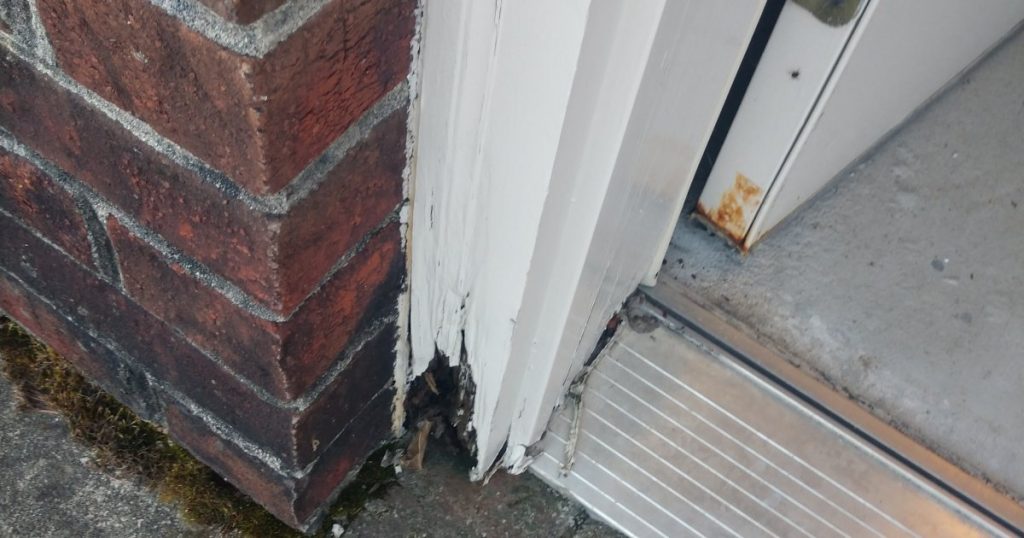
It had gone from needing paint to actively rotting. We brought it up again. Same answer – not right now.
We want to be fair here, because this is not a story about somebody being foolish. It’s a story about how these things look. A door frame that needs paint does not feel like an emergency. It doesn’t leak, it doesn’t make a noise, nothing stops working. There’s no moment where it demands attention. It just quietly gets worse in a place nobody looks.
Nine months after that
The call was about water in the basement.
The basement ceiling was damaged. So was the wall. So was the trim, and the carpet. Somebody was going to have to find where the water was coming from before any of it could be repaired, and by the time water shows up in a basement it has usually been travelling for a while.
It was the front door frame.
The rot had gone through the frame and into the framing behind it, water had been running down inside the wall, and it had been doing that long enough to do real damage on its way to the basement floor.
The numbers, because the numbers are the point
The basement repair came to about $7,500. The door unit and the rotted framing behind it added roughly $2,800 more. Call it $10,300.
The paint job, three years earlier, was about $200.
We’re not telling this story to make anybody feel bad, and the homeowners were good people who made a completely ordinary decision. We’re telling it because it is the clearest example we have of the thing we spend most of our time trying to explain: the small thing and the big thing are the same thing, separated by time.
And it isn’t a one-off. A $60 caulk-and-paint on a porch column that got left became a $650 column replacement. A $250 soffit repair became $4,750 once the water got behind it. A $75 piece of door trim became $7,395 by the time mold remediation was involved.
The multiplier is not fixed, but the direction never changes.
Why it’s always water
Almost every expensive repair we do started as water getting somewhere it wasn’t supposed to be.
Water doesn’t need a hole. It needs a gap – failed caulk, a lifted flashing, a place where paint has worn off wood. It gets in, it goes downhill inside the structure where you can’t see it, and it does its damage a long way from where it entered. That’s why the leak shows up in the basement and the cause is the front door.
Which also explains why this is so hard to catch by living in the house. Nothing about the basement told anybody the problem was upstairs at the front door.
The walk-around that catches it
This is a September job, and it takes about twenty minutes.
Walk the outside of your house slowly and look at every place two materials meet. Around doors. Around windows. Where trim meets siding. Where the deck attaches. You are looking for gaps, cracked caulk, and any bare wood where the paint has given up.
Press on wood trim near the ground with your thumb, especially around exterior door frames and the bottoms of posts. If it gives at all, that’s rot, and it’s already further along than it looks.
Look at your gutters and think about where the water goes when they overflow. Check that downspouts actually carry water away from the foundation rather than dumping it beside it.
And look at the thresholds under your exterior doors – the flat piece you step over. That’s the exact spot in this story.
Anything you find in that twenty minutes is cheap in September. Most of it is caulk and paint. All of it gets more expensive every year you leave it.
What we’d rather do
We’d rather come out and paint a door frame than replace a basement. It’s a smaller job and we make less money on it, and we would still rather do it – because the customer who never had the $10,300 surprise is the customer who calls us for the next 20 years.
If you’d rather somebody else did the walk-around, that’s what we do. We’ll come look, we’ll show you what we find, and we’ll tell you what can wait and what can’t.