What We Found Behind Five Drafty Doors
 A+ Handyman · Winchester, VA
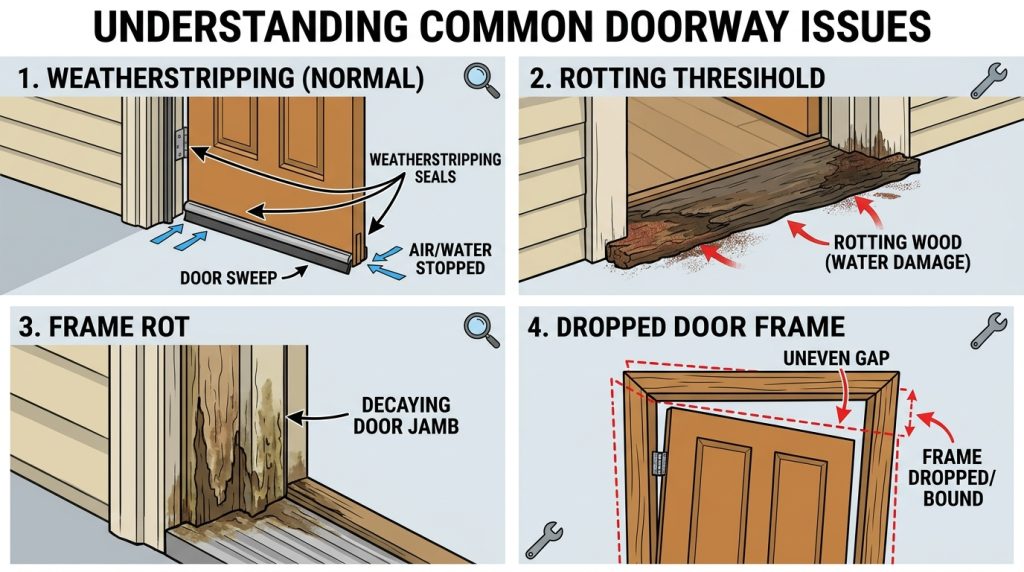
Every October the phone starts up with the same sentence. “I think I need new weatherstripping.”
Sometimes that is right. Most of the time it is not, and we would rather explain why than sell somebody a strip that will not fix it.
We went back through the door calls from this month – five of them. Here is what was actually wrong.
The strip was the problem on one of them
One door out of five. On that one, the foam had gone hard and taken a set, so it was not springing back against the slab any more. You can usually tell by pressing it with your thumb: good weatherstripping pushes back, tired weatherstripping stays squashed.
That is a genuine strip replacement and it is a quick job. One out of five.
The threshold was the problem on two
This is the one people miss, because you do not feel a threshold draft standing up – you feel it at ankle height, and by the time it reaches you it feels like it is coming from the whole door.
Thresholds wear from the middle out. Twenty-some years of feet, and the sweep on the bottom of the door no longer touches in the centre even though it looks fine at both ends. Put a piece of paper under the closed door and try to slide it – if it moves freely in the middle and drags at the edges, that is your draft, and no amount of new weatherstripping around the sides will change it.
The door had dropped on one
Doors sag. The hinges wear, or the screws in the top hinge lose their bite in the jamb, and the whole slab rotates a fraction of an inch. Now it is tight at the top on the latch side and open at the bottom, or it catches when you close it and you have got into the habit of pulling up on the handle without noticing.
Sometimes that is a longer screw into the framing behind the jamb. Sometimes it is a hinge. It is very rarely the weatherstripping, and putting fatter weatherstripping on a dropped door just makes it harder to close.
The frame was rotted on one
This is the one we would want you to catch early.
Water gets in at the bottom of the jamb – usually because the threshold has failed, or the storm door traps water against it, or there is no overhang on that side of the house. The brick mould and the bottom of the jamb go soft, and because it is all painted you cannot see it. Press it with your thumb; if it gives, it is gone.
That is carpentry, not weatherstripping. It is not a disaster if you get it in October. It is a much bigger job if the water spends a winter in it and gets into the framing behind.
Why we are telling you this
Because “I need weatherstripping” is a diagnosis, and diagnosis is our job, not yours. You do not need to know which of these five it is. You need somebody to look at it and say honestly which one it is – including the times when the answer is “your strip is fine, save your money, the threshold is what is beating you.”
Twenty-eight years in business around here means we are going to run into the same doors again in five years. There is no version of this where selling somebody the wrong fix works out for us.
The one you can check yourself
Close the door on a bright day and turn the lights off inside. Then look at the whole perimeter.
If you can see daylight anywhere, air is moving there. Where you see it tells you a great deal: daylight at the bottom middle is the threshold, daylight along the top of the latch side is usually a dropped door, and daylight in one small patch on the hinge side is usually the strip.
That is a two-minute test and it will tell you more than standing there feeling for a draft with the back of your hand.
If you can feel a draft or see daylight around a door, let us come look before the cold sets in. Free estimates, and it is often smaller than people expect.