The Fall Visit: What We Check Before the First Freeze
 A+ Handyman · Winchester, VA
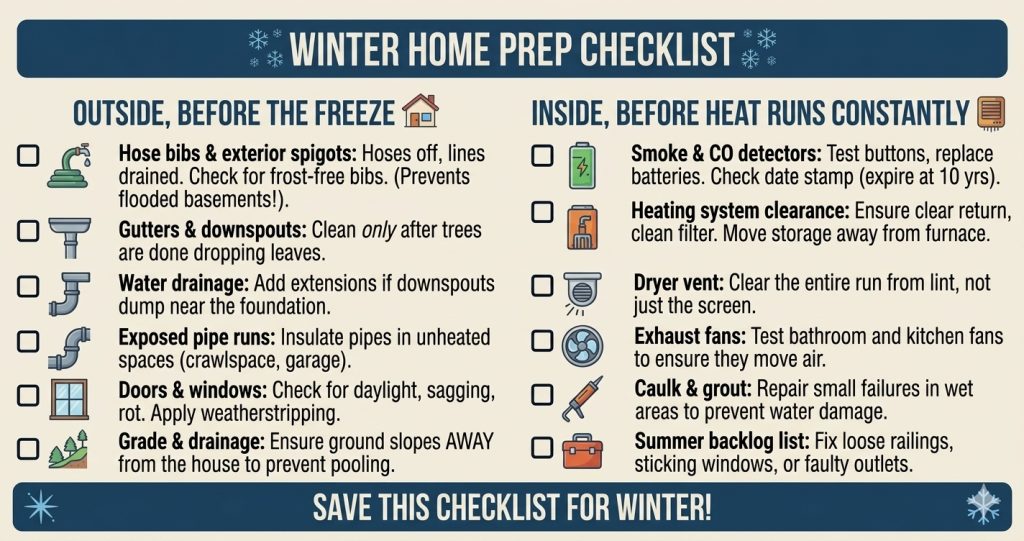
People ask what the maintenance plan actually gets them, which is a fair question, because “maintenance plan” could mean anything.
Here is the honest answer for this time of year: it is a walk-around, done in the right month, by somebody who has seen what happens when it is skipped.
This is the fall list.
Outside, before the freeze
Hose bibs and exterior spigots. Hoses off, lines drained, and we find out whether the bibs are frost-free or not. This is first because it is the one that floods basements.
Gutters and downspouts – but only if the trees are done. If they are not, we tell you and come back. Cleaning them in the wrong week means paying twice.
Where the water goes at the bottom. Downspouts that dump at the foundation corner cause more problems than clogged ones do. Extensions are cheap.
The exposed runs. Crawlspace, garage, anywhere a pipe passes through unheated space. Insulation goes on anything that needs it.
Doors and windows. The daylight test, thresholds, and anything sagging. Fall is when weatherstripping earns its keep, and also when we find rot in a jamb while it is still just a jamb.
Grade and drainage. Where the ground slopes towards the house, that is where winter water goes. It is not always fixable in an afternoon, but it should be on your radar before it is under ice.
Inside, before the heat runs constantly
Smoke and CO detectors. Every one, batteries and test button, and we check the date stamp on the back – detectors expire, usually at ten years, and most people have never looked.
The heating system’s clearance. We are not HVAC and we will say so, but we can see whether the return is blocked, whether the filter is filthy, and whether somebody has stacked storage against the furnace over the summer.
The dryer vent. October is Fire Prevention Month for a reason. Lint packs the run a little at a time, and a dryer that needs two cycles is telling you the vent is full. We clear the whole run, not just the screen behind the machine.
Bathroom and kitchen exhaust fans. These matter more in winter than summer, because the house is shut. A fan that is not actually moving air is how you get a mould problem in February.
Caulk and grout in wet areas. Small failures let water into places you will not see until spring.
Anything that has been on the list since June. The loose railing. The sticking window. The outlet that only works sometimes. October is when we clear the backlog, because November through February the calls are all emergencies and there is no room in the day.
What we are actually doing
Looking for the cheap version of expensive problems.
Almost everything on that list is a small item now and a large one later, and the size of the gap is entirely down to timing. A rotted jamb in October is carpentry. A rotted jamb in April is carpentry plus whatever the water reached over the winter. A hose bib in October is a small repair. In February it is a restoration company.
None of that is dramatic and none of it makes a good story. That is rather the point. The best outcome of a fall visit is that nothing interesting happens all winter.
You do not need us to do this
Genuinely – print the list and work through it yourself. Most of it is a Saturday and a ladder you should not be on.
What the plan buys you is that it happens in the right month, by somebody who has done it a few hundred times and knows what a soft board feels like through paint. If that is worth it to you, ask us about it. If it is not, take the list anyway. We would rather your basement stayed dry either way.
If you would rather somebody just handled the list, that is what the maintenance plan is for. Ask us about it next time we are out, or call (540) 550-2856.