What we actually check when we come out on a maintenance visit
 A+ Handyman · Winchester, VA
We started the maintenance plan in 2012, right after Hurricane Sandy.
That storm generated weeks of repair calls, and what stuck with us afterward was how many of them were preventable. Not the storm damage – you can’t prevent a tree coming down. The other ones. The gutter that had been failing for two years and finally gave up under the water. The flashing that was already loose. The door frame that had been drinking for three seasons.
The storm didn’t cause most of that damage. It just collected on it.
So we built something for the people who would rather not find out that way. Fourteen years later we have members who have been on it since the beginning, and the thing we hear most often is not about money saved. It’s that they stopped thinking about it.
What actually happens when we come out
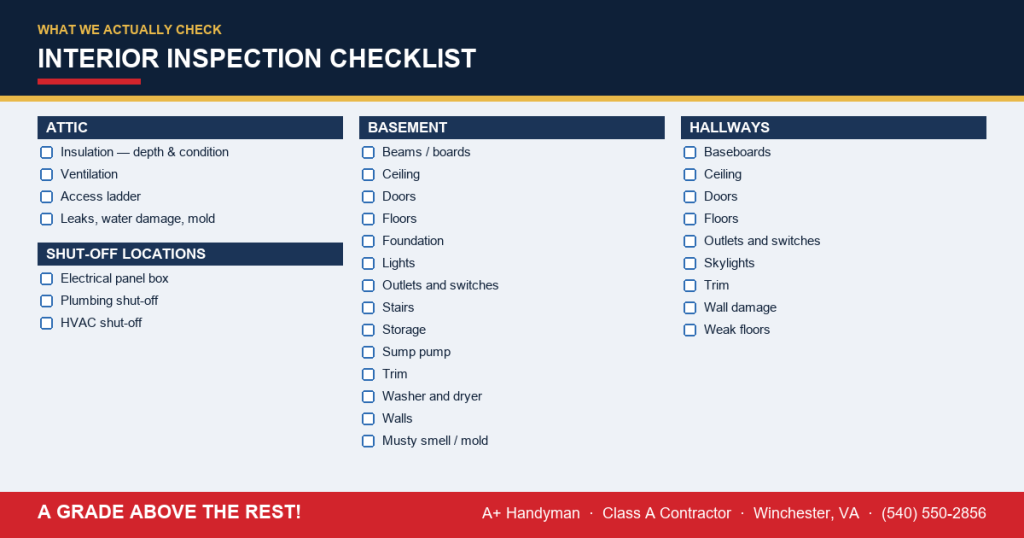
A checkup is not somebody glancing around your living room. It’s a walk of the house, inside and out, looking specifically at the places that fail.
Outside, we’re looking at every joint where two materials meet, because that’s where water gets in – around doors and windows, where trim meets siding, where the deck ties into the house. We check caulk and paint on exterior wood, especially low down where it stays wet longest. We look at gutters and where the downspouts actually put the water. We look at the roof from the ground, and at flashing anywhere something penetrates it. We check exterior door thresholds and weatherstripping.
Inside, we’re looking under sinks for the slow drips that have been going long enough to swell the cabinet base. Around toilets for the soft spot in the floor. At water heaters, at ceiling stains that indicate something above them, at exhaust fans that vent into an attic instead of outdoors. We look at what the previous owner did, because in older houses around here somebody has usually had a go at something.
And we write it down. You get the list, including the things that are fine. Knowing your roof is fine is worth something too.
What we find most
If we had to bet before walking up to a house, we’d bet on caulk. It’s the cheapest material on the building and it fails first, and when it fails everything expensive starts.
After that: gutters and downspouts moving water to the wrong place. Exterior wood trim losing its paint. Slow supply-line drips under a sink that nobody has looked at since they moved in. And rot at exterior door thresholds – the specific spot that cost one household $10,300 a few years back, which is a story we tell often enough that our own crew is tired of hearing it.
None of these are dramatic. That’s exactly the problem. Every one of them is cheap on the day we find it and expensive two years later.
Who it makes sense for
We’ll be straight, because signing up somebody it doesn’t suit helps nobody.
It makes the most sense if you own an older home, or one with a lot of exterior wood. If you’re not comfortable getting up on a ladder any more, or would simply rather not. If you own a place you don’t live in full time. If you have had one of these surprises before and would like not to have another. And if you’d rather have a number you know than a number you find out.
It makes less sense if you genuinely enjoy this work and do it yourself every fall. Some people do, and they do it well, and they don’t need us.
There are three levels
The difference between them is how often we come and how much hands-on work is included when we do.
At the top, A+ Honor Society at $69.99 a month includes a checkup every three months with five hours of maintenance work included, a three-year rate freeze, and free trip charges on an emergency and a service call. A+ High Honors at $49.99 is a six-month cycle with two hours of work included and a two-year rate freeze. A+ Honor Roll at $39.99 is a six-month inspection.
All three include priority scheduling and the emergency line – and priority matters more than it sounds. When there’s weather and everybody calls at once, members go first.
We have fifteen members today. We’d like more, and we’re being open about that rather than pretending otherwise. But we would rather have the right fifteen than the wrong fifty.
Why we’re mentioning it in September
A checkup before winter catches the things that winter makes worse. Water that’s already getting in freezes, expands and makes the gap bigger. A gutter that’s marginal in October fails under ice in January.
September and October are when this is worth doing, and they’re also when we have the time to do it properly.
If you want to know what a checkup on your house would involve, just ask. We’ll tell you what we’d look at and roughly how long it takes. No obligation, and we won’t chase you afterward.