A $12 Hose Bib and a Flooded Basement
 A+ Handyman · Winchester, VA
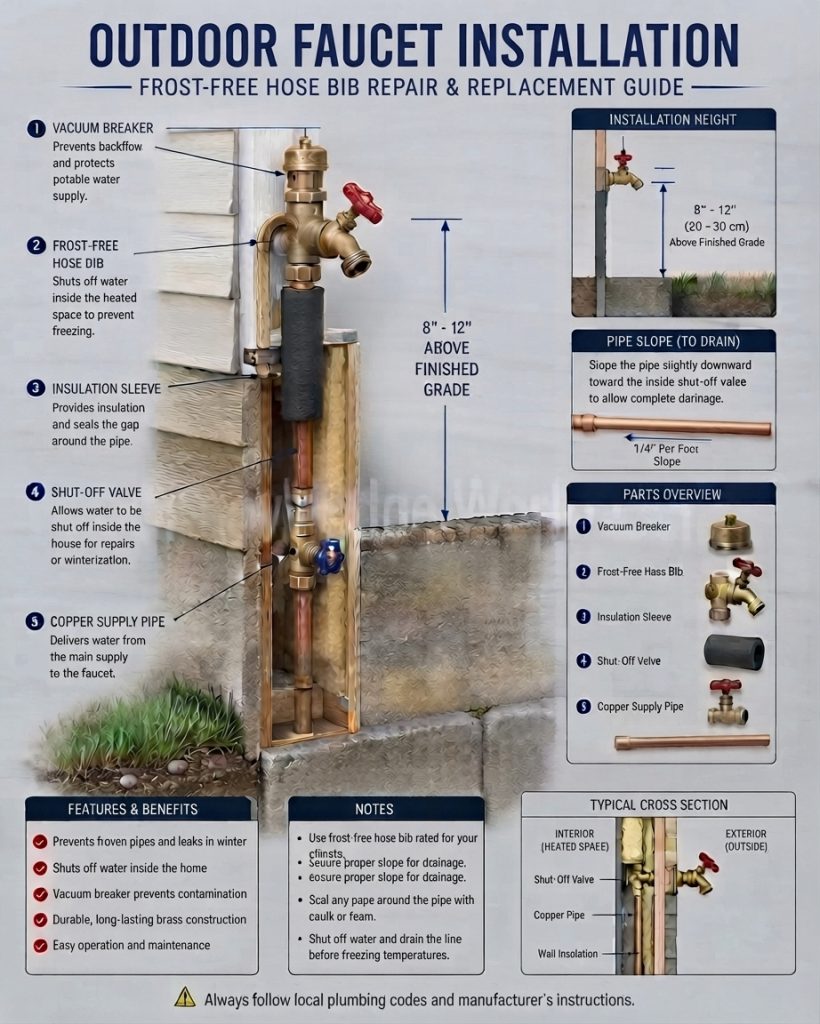
We are going to spend a whole post on a garden hose, because this one costs more than anything else on the fall list and takes the least time to prevent.
Here is the failure, start to finish.
You leave the hose connected in October. It gets cold in December. Water sitting in the hose cannot drain, so it freezes, and the ice backs up into the spigot and into the pipe behind it. Ice expands. The pipe splits – usually a few inches inside the wall, where you cannot see it.
And then nothing happens. That is the part people do not expect. It is still frozen, so it is not leaking yet. The split sits there quietly through the cold snap.
Then it warms up, you or the thaw opens that line back up, and now there is a split pipe inside your wall with the house pressure behind it. If it is above a finished basement, it can run for days before anybody notices, because the first sign is usually a stain on a ceiling, not a puddle.
The math
A frost-free hose bib is not an expensive part. Having somebody install one properly is not an expensive job. Call the whole thing a small repair.
Now price the other side. Water in a finished basement means drywall out, insulation out, flooring out, and a drying company with fans in your house for the better part of a week. Then mould remediation if it sat. Then the rebuild. We have been in the trade forty-two years between us and we have seen this one land in the five figures more than once – and every single time it started with a hose that stayed connected.
We do not publish rates, so we are not going to put a number on the repair here. But you do not need our number to see the shape of it. One side of this is a small autumn job. The other side is a claim, a deductible, and six weeks of your basement belonging to somebody else.
The five-minute version
You can do most of this yourself this weekend.
Disconnect every hose. All of them. Drain them and put them away – a hose left full will also split, and a hose is a lot cheaper than a pipe but it is still money on the ground.
Open the spigot after you disconnect. Let whatever is in there run out. If you have a shut-off inside for that line, close it first, then open the outside spigot and leave it open so the line between them can drain.
Find out if your spigots are frost-free. A frost-free hose bib has a long stem that puts the actual valve back inside the heated wall, so the water shuts off well behind the freeze line. From outside they look nearly identical to the old kind. If your house is newer you probably have them. If it is older, you may not, and it matters – a frost-free bib with a hose left on it will still burst, because the hose stops it draining. Frost-free is not hose-proof.
Then walk the rest of the exposed pipe. Crawlspace, garage, the back of a cabinet on an exterior wall. Anywhere a line runs through unheated space is a candidate for pipe insulation, and pipe insulation is the cheapest material in this entire post.
Where we come in
Honestly? For a lot of houses this is a homeowner job and we would rather you just do it.
Where it is worth a call: if you do not know where your shut-offs are, if you have got a spigot that drips after you close it, if there is copper running through a crawlspace with no insulation on it, or if you have had a line freeze before. That last one is the big tell. Pipes that froze once are usually in a spot that will freeze again, and moving or insulating that run is a far better use of an October afternoon than doing all this again next year.
Everything on the fall list is cheap in October and expensive in March. This is the one where that gap is the widest.
If you are not sure whether your spigots are frost-free, or where the shut-off is, we will walk it with you. Free estimates, and this is usually a small job.